2 August 2006

Perspective - a culture of low standards

It is quite amazing how much we are influenced by the people around us and their habits. It happens in every sphere of life (I could give thousands of examples but a moments thought will surely reveal them). Climbing is no different. Have you ever ended up bouldering with some new people at the wall and found yourself picking up their habits. Niall McNair climbs with a very positive-aggressive technique style. My normal style is fast but careful. After a day out with Niall I find myself naturally climbing more like him. We are incredibly limited by our own inhibitions and habits and they work on us without us even noticing. When doing strength research in a sport science lab it never fails to amaze me the immediate effect on a subject’s muscular output just from screaming “COME ON!” at them. And yes, the effect has been soundly proven. Basically you are saying ‘it’s OK to let your guard down and give it your all’.

The national average standard for climbers in the UK is very low – VS/HVS from what I gather. Ask most climbers and they will tell you they would like to be climbing harder. You can bet a VS climber would be more likely to make it happen if 90% of climbers were at E4. It takes bit of courage to break out of the normal culture – it takes some individual thinking.

Interacting with as many people, places, habits, and resources as possible that have a ‘social norm’ that oozes a high standard of quality, performance, effort, whatever the variable, will work its way into your norms. Yes, believe is or not if you spend all your time climbing with good climbers (good in some respect, not necessarily grade, maybe just effort level) it rubs off on you without you even knowing it. It’s quite a marvellous feeling when it happens! If none of your climbing mates train, will you go and train on your own while they go to the pub? If you live in the Spanish Basque country and EVERYONE climbs 8c including the females these days, will you stick at VS? Of course there is a balance to be struck between your climbing goals compromising the places and people you spend your time with, but most peoples balance has room to shift a little. You only get one life and there are many paths through it, you might as well choose a good one.
We need more data!

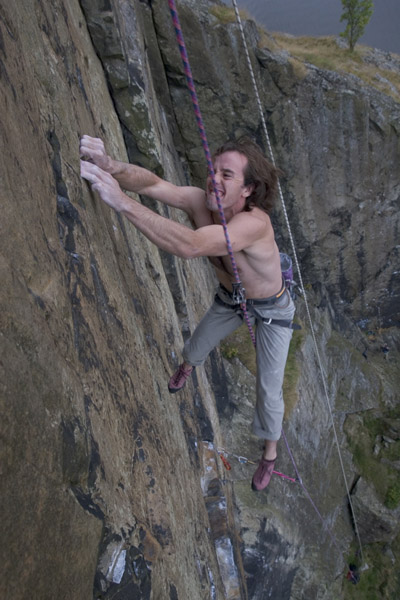
Working moves on Rhapsody June 2005. I kept a training diary all summer so I made sure I didn't skip any sessions while still getting lots of days on the route (Photo: Steven Gordon)

Well its good to see interest in this site starting to get going already - wow! In the comments for my last post Lee from Australia gave us a link to his training diaries article. Lee admits to being fanatical about training and I'm guessing very few of us keep training diaries in the long term. So should you? Well, probably yes! I only keep one for a couple of months of the year when I'm not climbing, just training specifically for something. Last year when I was training for Rhapsody I kept one for three months because I had so many training objectives to fit into the training week - fingerboard sessions, endurance circuits, flexibility, running and I was trying to get 4 sessions a week on the route itself. You might say 'well why not just allocate a weekly routine with set tasks on Mon, Tues etc..' Well yes thats fine if you can do that, but most peoples lives aren't so simple. And if you are trying to do your real climbing outdoors then you have to schedule around the weather. So all in all its easy to lose track of your volume and it inevitably slips either side of the optimum.

I tend to keep track of my yearly volume in my head because training comes first in my daily schedulea and I think about it non-stop. But for most thats not the case. If you want to improve year on year you NEED to be sure you are doing more training/climbing load than last year, otherwise your body won't adapt. The Scotland Online article on the links page has more on the overload principle. It's always an eye opener when you write down some detail on how much time you spend training - it always makes you realise just how big the gaps are at certain times of year when life gets in the way. If these gaps were smaller, a lot of people would be climbing a lot harder.

1 August 2006

Climbing training web crawl

I've just spent way too long in front of the screen crawling the web for the best online sources of information of training for climbing. So the link list is looking a little better now and has enough for anyone to get started learning about training techniques for climbing. My experience of searching the web for these resources showed me that there are a few excellent resources (such as Eric Horst's sites) but that is set amongst much poor writing and questionable advice. What you see on the links list is probably only 20% of what is out there as much of it doesn't really come up to scientific standard. My aim with this blog is to keep an extremely high standard of information, so links I include are preferably written by authors with a background in contributing to science in the field or top level climbing. So as I build up the links over time it will be a 'one stop' resource of trustworthy and carefully edited links.

I also ran many searches and identified many gaps in written guidance on the web, especially in our specialisms here in the UK; trad and winter climbing. So they will be my priorities over the coming weeks as I add more articles to davemacleod.com articles page. I'll also be doing some much needed interviews with well known coaches and climbers and hopefully learning some of their secrets.

If you know of any good links, or want to comment or request specific links or information, email me (my email is the first link). This is your service - use it to get better at climbing.

29 July 2006

Tactics - 'Free' improvement

Tactics are too often forgotten in our quest to get good at our climbing. A climber once asked me if he should train to lock off on one arm for several minutes to prepare for placing gear on a steep grade IX in the Cairngorms. That would be one way, sure (taking several years of effort no doubt). But another would be to learn to place the gear in 30 seconds rather than 5 minutes. Tactics.

Its good to be focused on getting strong an fit, but not good to focus on it at the expense of methods to sidestep the need to get strong and fit. I'll be adding many sources of advice on tactics over the coming weeks to the links section. To Kick off, check out Andy Kirkpatrick's site

www.psychovertical.com

Andy is a walking encyclopedia of clever tactics and trick to get the most out of your gear and systems while climbing. Many of these come from alpinism, but can be applied to any type of climbing.

davemacleod.com now running


davemacleod.com is up and running now. Apart from information and images of my own climbing, you can find articles about training for climbing, preventing and dealing with injury, details of my climbing coaching services and upcoming lectures.

Introducing the Online Climbing Coach blog

My name is Dave MacLeod, I am a sport scientist, climbing coach and pro climber based in Glasgow, Scotland. You can find out more about me at my website. I decided to start this blog to share all the information and experience I carry around in my head and read about all the time, providing a good resource of advice about training for climbing. I'll be dissecting the latest research, analysing and reporting news and other people's work on the subject and providing links to good sources of information elsewhere.

I originally studied sport science to help me coach myself and take my climbing as far as it could go. My study helped me so much and I wan't to make it easier for others climbers to access the same knowledge and apply it.

I'm sure I'm going to enjoy this blog. I hope you do to and it helps you climb better and harder!

Dave Macleod