6 September 2006

speedlinking Sept 6th - pro-tips videos

Freakclimbing has three interesting pro-tips videos with Jared Roth, Lauren Lee and Malcolm Smith.

The first two are not hugely in depth from a training point of view but still interesting watching. Lauren Lee talks about how body strength was a limitation she's worked on. We see her doing some basic core exercises and talking about targeting steep and burly bouldering, rather than avoiding it like many do! This type of strength will inevitably be a limitation for female climbers, unless you do something about it. It's nice to see her putting her money where her mouth is by grunting through some V9 roofs on the clip.

Malcolm is talking about the benefit of working front-on body positions and big moves to the side during training. I emphasize the during training part. This is not a formula for technique, where twisting and Egyptians are essential to get the most from the feet. What I think Malcolm is saying is that its worth working on front-on moves in training (he demonstrates some system style board problems in the clip) so that when you do come across a move outside where there is no option but twist, that strength is there.

This is always the danger with spending a large proportion of your time training on boards - you can start to see all climbing through the lens of what you do on your training board and a broad range of techniques (especially clever footwork) gets neglected and you forget to use it. A balance between the two extremes is needed.

The clips are here.

Fingerboard choices

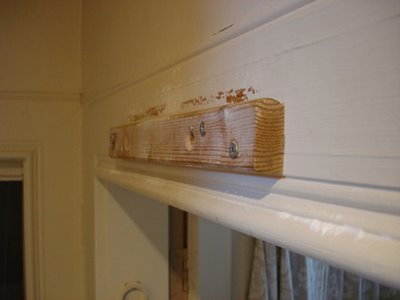
Several folk have emailed to ask about choosing a good fingerboard and how to use it once you have one. A fingerboard doesn't need to be fancy in any way, it just needs to be used! All it needs is to have a small enough edge that's first joint (20mm is good) and to have a rounded edge and smooth surface so your skin doesn't hurt. That's all. Above is my fingerboard. It's an S7 campus rung screwed to my doorframe. You could easily make the equivalent for a few pounds from B&Q. One like this instead of a big orange resin moulded thing is less intrusive in your living room too.

I've written some notes about how to use them in my rough guide to physical training on my main site (on page 4 here). The key thing about fingerboards the workouts are very short - play a CD through as you do your hangs, and you're done. The flip side is you need to keep up the dangling for a large part of the year to keep moving up through grades. Most people get bored with them either because they don't like training on their own or the activity itself seems to monotonous. Put your fingerboard up in your living room or kitchen and use as you watch the box, chat to partners, or whatever you spend a lot of time doing.

I've heard people say of fingerboards "but they are only for people who are strong", as if somehow if you lead VS it wont make any difference. Fingerboards make weak people strong. If you are weak, then you need them more than anyone!"

More articles about fingerboarding on the Moon site here

4 September 2006

davemacleod.com updates - coaching services

I've updated the coaching section of my main site to give you more details about whats included in my climbing coaching services and the different levels on offer. Please let me know if there are any questions left unanswered when you look through these! You can find all the details here.

I've also added a shop page where you can find lists of books on training for climbing by Amazon and buy climbing DVD's, including pre-orders for the E11 film (coming out late October).

Technique drills - breaking down moves

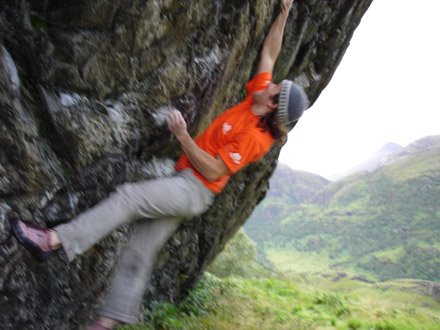
This post looks at how moves fit together on steep rock. Hopefully by breaking moves down into their components I can illuminate the crucial stages of each type of move. Because overhanging rock makes the holds feel poor, we often have to make dynamic moves or twist our trunk to get more reach without having to pull up higher on the holds. Below I've broken down the movements of Catch 22 Sit Start V10 in Glen Nevis, which gives a good example of moving on a flat steep wall.
1. The first move is an RH (right hand) reach. The most important thing to notice is that my trunk is facing left, not straight onto the rock. In fact my hips are almost facing the camera. Why? Well, twisting left means my right shoulder is twisted in towards the rock, closer to the hold I'm reaching for. It also means my centre of gravity is pulled closer to the rock = more weight on my feet. My left leg is pushing - creating the body twist and pushing up into range of the next hold. My right leg is pulling my right hip into the rock and is bent, ready to generate the upward momentum to the next hold.
2. Here I am moving my feet around to get in position to reach with my left hand. It's at this point in moves where many climbers go wrong. It feels natural to pull up and then move your feet. But the best way is often to keep your arms straight, move your feet FIRST until you can see that they are in a good position for the move, then pull up. Pulling up on the holds is likely to increase the force you need to generate at your fingers. If your feet are already in position, you can use them to generate the force. Note also it's OK to make several small foot moves. Big reaches with your feet often increase the force at the fingers where several smaller footsteps avoid this.
3. Here I'm in position to move. If you've never seen one of these moves before it's called an 'Egyptian' or 'drop knee'. The second name is more descriptive - basically you are just dropping a knee to help pull inwards and/or diagonally with on foot. I've dropped my left knee which pulls my left hip towards the rock (giving me reach on my left side) and generates more inward force to replace that provided by my left hand as I take it off and reach for the next hold. Note my left toe is really pointed into the foothold and I'm really pulling hard with it. On steep rock this type of move is essential to know if you want to progress.
4. I've completed the Egyptian move and now need to bring my right foot up. Can you see how my centre of gravity (near hips) is now further in (to the left as we look from this angle) than my hands which are both high, and hence further out? This is creating a tendency for my lower body to swing out (i.e. cut loose). I'm pulling in with my feet and keeping tension through my whole body to avoid my feet slipping. But as I move my right foot I need to be really aggressive with my left toe to prevent it slipping off. Mentally I'm also using this moment to gather composure and focus for the crux dyno which is coming next.
5. Ready to move again. Note legs bent ready to thrust upward, arms almost straight (I think I'd started to move as the photo was taken), focusing in on the next hold.
6. Go! Most of the upward thrust has come from my right leg. My left leg is controlling the rotation of my body and also momentarily pulling my lower body inwards to limit the swing. My left hand is doing almost no pulling upward, only pulling inward. I'm still focused on catching the finishing hold accurately and I'm ready to pull like hell on it as soon as I get my hand on it.

Summary: Lots of twisting going on - this helps give you reach without having to pull up and also brings your centre of gravity closer to the rock which means more weight on your feet. I'm only executing each hand movement after I've moved my feet and body into a good position to support me. Most of the stages of preparing to make a hand movement happen with my arms straight or nearly straight.

31 August 2006

Training for climbing books

Amazon have just set up a feature for folk who run websites to make up a page in Amazon with books relevant to their readers. I've set one up here with books about training for climbing (theres a link on the sidebar too). So I hope you find it useful to see whats out there - there are a lot of titles to choose from these days! Talking of which I'm going to try to post reviews of as many of them as I can in the coming weeks to help you choose one. The difference in quality between the best and worst is huge! My favourite is still the old school Goddard and Neumann book, even though a couple of parts are slightly dated from a sport science point of view. The Amazon Astore feature is still in beta at the moment and they need to improve it a bit, but hopefully soon they'll allow us to customise the book catergories better and populate lists better so the service is more useful for you.

Home training facilities - direct comparisons

Michael asked what are the relative merits of different types of home built climbing/training facilities. The answer is always to build as big and good a facility as space/spouse/landlord allows. Bouldering is the most effective training for climbing overall because you learn technique and can work on any aspect of strength and fitness at the same time. But not everyone has the space or the inclination to build a bouldering wall in their house. So lets have a look at the options:

Bouldering Wall

Pros: You can work on strength or endurance, but all the time you are doing whole climbing moves and thus learning technique. Its also much easier to cover and target all aspects of strength you need to work on (e.g. pinches, big moves, undercuts etc).

Cons: Takes up a lot of space. You might end up trying to use it to solve all your climbing weaknesses (which it won't!) and become a super strong wall rat with no technique or tactics.

System Board

Pros: If you already do a lot of real climbing and thus your technique gets lots of work, a system board might be more effective for working on strength. Especially useful for training for a specific type of climbing (e.g. Frankenjura pocket routes). More measurable than bouldering for improvements.

Cons: Again, becoming addicted to it and overusing it at the expense of other training priorities.

Campus Board

Pros: Very effective for gaining strength on big moves and small holds. Doesn't take up as much space as a wall.

Cons: Only useful if you already climb a lot and if used as a supplement, NOT SUBSTITUTE, for this climbing. It can subconsciously alter your technique away from a reliance on footwork if you let it.

Fingerboard

Pros: Takes minutes to set up and takes up no space and no money (mine cost less than £10 to make and install). You can put it wherever you spend the most time so you can get steely fingers while watching the box, working, whatever. Easy to build into a busy routine because the sessions are so short - just about everyone can find half an hour in their day.

Cons: It's boring if you don't play music, watch telly, chat to folk or work while your doing it.

Weights

Pros: Can be stored away.

Cons: Can waste your time by working muscle groups that are not weaknesses in your climbing and taking your time away from learning climbing technique. So only really useful for people who already do all of the above or have some significant lack of body strength in a specific muscle group.

Time poverty and ways round it

Lots of people who ask me about what types of training they should be doing have one major thing in common - lack of time. They only have time for two climbing sessions in the week and aren't sure how best to improve. The answer to this depends partly on what stage of development you are at with your climbing and whether the lack of time is permanent and year round.

For people without many years of climbing behind them and those climbing at lower grades, increasing the number of climbing moves you make each year is often top priority. There is no point being 5% stronger if you don't have technique with which to apply it. For those who move very well on the rock and have tactics very well sussed, strength is more likely to be the biggest barrier to the next grade.

But there are 2 more points to bring up here:

1. If your routine (and time available to climb) changes during the year you can use the busy times to build in some strength training (preferably boulder supplemented by some basic strength work). This works well because busy times tend to be quite regimented which makes it easier to discipline yourself to spend a session doing organised strength training. Also strength training takes the least training time - short, high quality sessions are exactly what youre after.

2. You need to find ways to spend your time efficiently too. Do you spend ages travelling to a wall? If so build one in the garage, or if you have a tiny flat like me just put up a fingerboard. If you want/need to use big climbing wall for routes and to meet friends then you could do a half hour session on the fingerboard before going there. When you arive you'll already be warmed up.

If your routine is just busy all year round and those two sessions are all you've got, then stick to training that involves actually climbing. But I feel most people can squeeze in very short additional sessions somewhere in their week, to work on basic strength as a supplement. For instance I fingerboard when I have reading to do (I work from home). Others will do half an hour at lunch. Others will put the fingerboard above the kitchen door and do a few hangs every time they are boiling the kettle!

29 August 2006

Many questions in my inbox!

The body is moving, but the finger flexors are contracting isometrically while hanging from the holds.

I've been really overwhelmed with the response to this site and my inbox is flooded with questions and ideas from you. Thanks! I will get round to answering them all and posting up the articles you've asked for, but I've had a great many so please bear with me!

Connor asked:
"For a long time now I have been questioning the effectiveness of training finger strength through traditional training techniques like deadhangs, finger board workouts, etc. All these exercises rely on applying weight to a static hand position, crimping for instance, until failure. But how effective are static isometric contractions for training strength? Other resources on general strength training I have read reject this type of training because it is relatively ineffective compared to engaging the muscle over a range of movement. If I were going to train my chest muscles, I would never just hold the bench press bar in a static position until I was tired. I can't figure out why exactly we train our fingers and forearm muscles this way. The flip side to my thinking is that climbing basically involves a series of isometric finger contractions to get up a route, so is this training simply sport specific, therefore effective?"

Connor has really answered his own question at the end. This comes down to the basic principle of specificity - you get good at what you do. Most sports require using a muscle through a proportion, or all of its range of movement and in a dynamic (moving) contraction rather than isometric. So mimicking this in training is needed. But with climbing we hang isometrically (isometric means the muscle is producing tension but not contracting - i.e our fingers stay still on the holds) from holds so must do this in training too. Of course we use different muscle lengths in the different grips (crimp, openhand etc) so this also has to be done in training because the carryover of strength at one muscle length is limited at another. So stick to the hangboards!

Isometric contraction is actually surprisingly rare in sport. Endurance of isometric contractions, or more specifically, intermittent isometric contractions in the case of climbing is very interesting from a physiological point of view because of the effect of the high intramuscular pressure on blood flow inside the muscle. There is some interesting research on this in the fields of dingy sailing (yes I know, I was surprised too!) and motocross (also a forearm fatigue issue in this sport). More on this later...

17 August 2006

Climber interview - Neil Gresham

Have a conversation about coaching and training for climbing and the name Neil Gresham is likely to come up pretty fast. Neil is undoubtedly the guru of training for climbing in the UK and has been for years. As well as being the most experienced hands on coach in the country, he has recently packaged much of techniques and tactics he coaches into two DVD's Which are basically a bible for how to move on rock and get to the top of tricky routes. Neil gets down to the nitty gritty of training every month in Climber magazine, so in my interview I tried to ask him some more overarching questions about his experience and general approaches for doing well at climbing.

Photo: Adrian Croome

OCC: Neil you're probably the most experienced climbing coach in the UK, and since climbing is still a young sport in its stage of development, you've had the opportunity to influence many of the trends in training for climbing. Can you pick out one or two key messages that you've tried to get across to climbers over the years that stands out as most significant and/or innovative?

Neil: I guess the most obvious one is that it’s hard to persuade climbers to plan, but if you can convince them to use the principles of periodisation as a guideline for their training then they’re going to climb so much better and be less likely to get injured. The other big one regarding technique is that you have to focus on style and looking good (yes, I know it goes against the grain!) rather than getting to the top at all costs. People find it hard to be mentally aggressive and physically relaxed at the same time, but that is exactly the state you are aiming for.

OCC: The first climbing magazine I ever bought has an article on redpoint tactics written by you, and I still refer to it occasionally now. Is there any piece of advice or writing from your early days that still keeps you on the right track today?

Neil: Yes, for sure, a classic example is the difficulty of getting both strong and fit at the same time seeing as they require such contrasting approaches. I once wrote a piece for OTE in the early 90s which described the requirements of stamina training as being quantity based and the requirements of power training as being quality based. Bouldering work-outs should be short, intense and with good rests in between, whereas stamina sessions should be long slow-burners with as little rest as you can get away with. If you want to develop both at the same time then you need to prioritise one for a while and then switch to prioritizing the other rather than going hammer and tongs with both. There are so many little rules that help out when it comes to coordinating strength training with endurance. For example, if you’re training 2 days on then it’s nearly always best to train strength on the first day, and so on. Another good general principle is that the best time to back off with your training is when things are going well, and this is of course the time when you are least likely to want to. That one has probably saved me from injury countless times.

OCC: I think it's fair to say your notoriety as a climber really took off when you moved beyond the hard sport climbing scene, started doing routes like Indian Face and generally became a super all-rounder. Do you think your attitudes to training and preparation helped you do this, or was it just your sport climbing fitness?

Neil: It was both. Sport climbing gives you a huge buffer for trad in terms of strength, endurance and technical ability. It’s clearly more of a chance game if you turn up at the base of an E9 knowing that F7c+/8a is your limit. It’s only the total headpointing gurus like Nick Dixon who can pull this off. But then it’s people like Dixon, Dawes and Grieve who are the masters of the preparation side and who taught me so much. None of these guys are really strong climbers but they developed a whole new way of looking at bold climbing. Parallels were drawn with the Samurai warriors who had to practice highly complex routines, knowing that the penalty for a mistake would be serious injury or death. Many of the tactics that have been coined both for preparation and for coping with mid-ascent catastrophes are pretty zen-like in nature. It’s a vast subject but the essence of it is to focus so hard on the delivery of spontaneous action that there is no space left in your brain for disrupting thoughts or emotions. There are a few lucky climbers who can turn this on straight away with minimal experience to draw on, but for me it took years to nurture. I was very timid when I started climbing.

OCC: It’s always seemed to me that 'natural talent' in sport can sometimes bring problems as well as benefits. Many climbers who have the most prolific careers have had rather ordinary abilities to start with that have catalysed a determination and work ethic that goes on to surpass the natural talents (who get too used to success without effort). Do you agree with this? If so, do you try to develop determination in your coaching and in your own climbing?

Neil: I couldn’t possible agree with this any more. So often the most talented climbers, especially the young ones are total slackers. In short, they don’t appreciate what they’ve got because they haven’t worked for it. There is nothing like being fundamentally un-talented to make you realize that you have to capitalize on the fleeting moments when you feel that you might be in with a chance. This ethos has defined my entire climbing career. It means that your finishing game becomes your strongest weapon. Can it be coached? Indeed it can! Let’s move away from nonchalant teenagers and look at keen but less-experienced adults – many just don’t know hard you have to try. It was Sean Miles who once told me that one of the big things that goes wrong with his climbing after a break is that he forgets how much effort you need to put in. This statement holds true both in the present sense (mid-climb) and also with your overall approach to training. Look at Rich Simpson and Chris Cubitt – these guys have sweated blood for it. The right attitude can be nurtured with anything from the use of key words as metaphors to tougher goal setting. There are all sorts of devices.
Photo: Adrian Croome

OCC: One issue that is often on the training climber's mind is body shape and how to best manipulate it. What have you learned about this in your experience? Do you think it is best to work with the frame you've got or become either a Dave Graham or a Malcolm Smith?

Neil: I think the answer is hidden in the question by the fact that you picked both those two climbers. They are both at the very top level and yet they have very different frames. It’s elementary stuff: to climb well you need a good power-to-weight ratio. Graham gets there on weight (or lack of it) and Smith gets there on power (or surplus of it). If you’re both heavy and weak then you’re not going to do very well. When Malc did Hubble he was both strong and ridiculously light but it was unsustainable and the combination of the dieting and the training nearly broke him. So long term he has settled to be strong, a little heavier and a lot happier! If you’re naturally a stockier build then you simply have to ask yourself how much you want it and how far you’re prepared to go. It’s easier for lighter framed people as they don’t have to think about all this! That said, a little extra muscle is a good thing for bouldering but for routes it only serves to weigh you down.

OCC: Can you describe roughly what elements you think would be involved training wise, if a climber set a goal of onsighting E9?

Neil: Are you asking for a bit of coaching advice here Dave?! After all, you’re one of few in the UK who’s in with a chance. Firstly I think this is a young man’s game. Leo Houlding was a contender when he was full of precociousness but he got older and worst still he became famous. I think it’s pretty important to still feel that you have something to prove, preferably just to yourself. James McCaffe was (and still is) another candidate. He has a very genuine love of climbing that isn’t media-driven and a high level of talent, but he got that big scare when he went off-line on Masters Wall and I think that really brought it home. It only takes one near miss to make you realize that the confidence building game we play is partly based on delusion. There are a few young lads who I’d like to mention here but to do so would be putting them at risk. If the media start rallying round with something as sensitive as this then the motives become cloudy and it gets even dicier. Back to the question – you need to be climbing outdoors a ridiculous amount and hence would probably have to give up any full time employment for up to 6 months. Here’s what I’d do if I was remotely in with a chance. Go to Europe in the winter and not come back until I’d onsighted 6 or 7 8as and 2 or 3 8a+s. Stop in Font on the way back to get my strength and technique back up and make sure I could flash Font 7cs and do 8as easily in a day. Do loads of onsighting all-round the UK in the spring, starting first with the safe, strenuous ones and then progressively moving on to bolder ones. I’d make sure I’d done a grade pyramid of 1 or 2 ground-up E8s, 6 or 7 E7s and well over a dozen E6s. All these routes would be in a full variety of styles, but then I’d pick my E9 and start focusing purely on that style. Then I’d start mental prep for the 9 and maybe do a few up-&-down style recces on the route. You know the rest. All yours, Dave!

OCC: As you know all too well, trad climbing in the top end E grades is a genuinely dangerous business. How do you decide you are ready to go for a lead you know will be at your limit with real consequences if you make a wrong judgment? What do you think it takes to walk away from a route when doubt creeps in just before you are about to lead it? Harder still, how do you coach these skills?!

Neil: My doctrine here is that there are two voices – the one in your head and the one in your guts, let’s call that one your sixth sense. If you ever let your rational mind over-ride the ‘sixth sense’ then you’re playing a dead man’s game! This may sound wooly and superstitious but if you don’t know what I’m talking about then you simply need to go out and do more trad climbing. Backing off teaches you the parameters and when the sixth sense says ‘go’ then you’ll trust it. But if you haven’t nurtured that inner voice tenderly over time then you have no referral device for your decisions. It’s like a final check: brain says ‘yes’, sixth sense says ‘yes’… ‘off we go then’. On the day I fell off Meshuga, everything was perfect on paper, conditions, skin, preparation, the lot. But something irrational inside me said ‘don’t do it’ and I chose not to listen. Never let your the to get it over with get the better of you. Be quiet, cut through the butterflies and the eternal chattering of your mind and listen to what your inner consciousness is really saying. And if it’s really saying ‘no’ then don’t go - an amber light is the same as a red one! You’ll know when the time is right.

OCC: Who in climbing have you seen or coached over the past few years that has really impressed you? What can we learn from their approach?

Neil: Natalie Berry has really impressed me and I wish I was able to do more work with her. There are climbers three times her age who’ve been climbing three times as long who haven’t worked out half of what she’d sussed by the age of ten. She has a rare grasp of the movement, her tactics are impeccable, she knows how to train and how to learn from her mistakes. To be honest, so many climbers impress me – Ben Moon for being so relentlessly good, Rich Simpson and Steve Mac for taking over where Ben left off so many years ago with sport climbing, Paul Craven for constantly re-inventing his climbing by switching styles, Charlie Woodburn and Matt Birch for over-coming debilitating illnesses and cranking to ever higher levels, you (Dave Mac) for being out there on your own and pushing both headpoint and Scottish winter standards, Oh and Ryan Pascall as a young climber who seems to know what to do with his talent. And also at a much more modest level, there are a few people who I’ve coached - there’s a chap called Paul Bate who’s in his late 40s, with a family and a who holds down a very demanding and high-flying position in the world of finance. On our first session he said to me ‘Now then Gresham, I don’t want any creepy bullshit from you – I pay you to tell me what I’m doing wrong, not what I’m doing right, so don’t spare me any punches!’ I slated him and he went from falling off 6a’s to onsighting 6b+ and redpointing 7a in 6 months.

OCC: I sometimes get the impression that climbing walls have generated a lot of impressively strong climbers, who try but don't succeed in matching this ability outdoors, especially on routes. For example, I was recently talking to a climber who's goal was to do Font 8a and French 8a, feeling that French 8a was the harder goal! What can climbers do to overcome this?

Neil: That sounds like crossed wires to me! Can it be true? I take your point that wall strength is easier to ‘convert’ than endurance because the head side of lead climbing usually sabotages things. However, the tactical side of both bouldering and sport climbing is pretty much the same outdoors as it is indoors. Converting the technique patterns of indoor climbing to rock is simply a matter of putting the time in. So what else can climbers do to overcome disparities? This depends on whether they mainly climb indoors due to time constraints, or whether they are cowering indoors because they are scared of the crag. The former climber will be super psyched when eventually they do get to the crag; however, they should still channel this motivation into skills acquisition rather than the short term desire to tick high grades. To the climber who is more timid, they need to ask themselves if they are genuinely scared of the crag or if it is more to do with their ego. If it’s a pride thing, then it comes back to ‘having a word with yourself’ (as Tim Emmett would say) and dropping the grade and going for mileage. Remember that the indoor and outdoor climbing grades will only equate for people who’ve put roughly equal amounts of time into both disciplines. Only push your comfort zone once you’ve established a base - this is surely the first thing any climber is taught. Regarding the specifics of crag skills – that’s too long to answer here. Sales pitch aside, have a look at my Masterclass DVD part 2!
(OCC: No really! No crossed wires! The psychological issue you brought up of being timid and feeling out of the comfort zone was what I was trying to get at with this question and example. I think that a lot of climbers aren’t sure how to go about training it)

OCC: The last one is a philosophical one: What is the benefit of getting good at climbing? Is it more enjoyable at E5 than HVS?

Neil: For me personally, I’d say that E5 is more enjoyable than V Diff or Severe but I wouldn’t say it’s necessarily more enjoyable than HVS. That depends on the quality of the route and a great HVS is surely better than a shit E5? I always used to look at Extreme Rock when I climbed in the lower grades and long to be pulling off proper moves on sheer faces rather than shuffling around on polished or vegetated ledges. For me there needs to be an element of exposure and technical intrigue and I can still find that on HVS. What you get from it seems to vary all the time – sometimes it’s the thirst for new experience in the form of increased mental or physical pressure that drives my climbing. But other times, if I can search out a climb that genuinely has something new and different to offer, then I don’t need to be pushing myself in order to obtain some value from the experience.

Thanks Neil! Neil’s masterclass DVD’s are a superb reference for just about all aspects of movement techniques and tactics for sport and trad climbing. A full review of these coming up soon. Check out Neil’s new site which has some great articles on training and tactics from climbers you’ll have heard of.

16 August 2006

upcoming climbing masterclass

I've put details of my next climbing masterclass up on davemacleod.com. Myself and Niall McNair are running the technique sessions at Alien Rock 2, Edinburgh alongside the Edinburgh Mountain Film Festival on 21st and 22nd October 2006. Full details here. They sold out a fair bit in advance last year so if you'd like to come then get booked up.