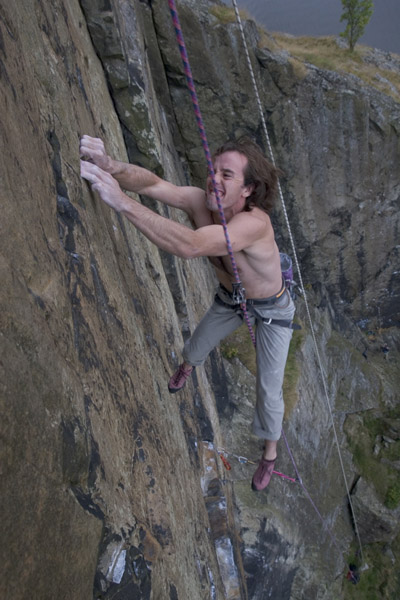
Climber interview - Lucy Creamer

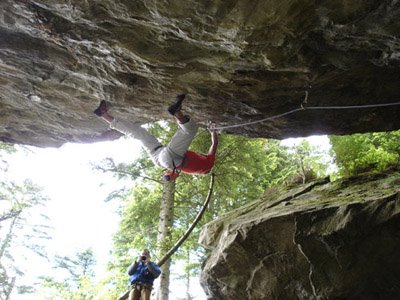
Photo: Tim Glasby
I’ve been lining up a series of interviews with top climbers, coaches and sport scientists and trying to ask them the questions that need asking to get right up to date with the best knowledge out there for improving at climbing. The first of this series is with Lucy Creamer. Lucy is the UK’s best female all-rounder; 6 times British indoor leading champ, onsighted trad E7 and sport 8a, redpointed 8b and M9 and climbed up to E5 on alpine big walls. You can find out more about her on her climbing interviews. We can find out a lot about improving from all-rounders because to do as well as Lucy has, you have to be able to make all the ingredients of performance; physical, mental, and tactical work for you. You need to really know your strengths and use them to transfer ability across different disciplines, while working efficiently on your weaknesses. In my interview I tried to get to the bottom of what Lucy’s transferable skills are, how she uses them, and how she makes up for weaker areas. I also tried to find out if there were any advantages or otherwise Lucy has experienced as a female climber and how she dealt with these.
OCC: You have onsighted on trad up to E7, which is still pretty much cutting edge in world trad onsighting. I think this is pretty remarkable since this is a lot nearer your physical limit than many of the men who have onsighted this grade. I know that a type of egotistical self-confidence can be used as a mindset to do bold climbing near your limit, whereas some people have a more confident but humble mental approach. What mental techniques or strategies have you used to commit yourself to bold routes? Do you think any particular style is effective or useful for female climbers in particular?
Lucy: One of my strengths in climbing is being able to push myself at my physical limit. It has always baffled me when I compare myself to others (in terms of pure physicality) as to why I can achieve harder onsight grades but as I said I think it has a lot to do with my mental attitude. When I get into physical extremis, I have the ability to override what is going on and push myself upwards rather than panicking and trying to retreat and or fall off. I generally only ever fall because I can actually physically no longer hold on.
I think climbing bold routes requires an inner self-confidence in your abilities and making tactical choices. i.e. I will never go on a route if I am feeling physically under par. For me one of the keys to climbing hard trad has been to do a lot of hard sport and therefore you know in the back of your mind you have the fitness to recover if you get in a pickle and get pumped and also you have the strength to pull off hard cruxes.
OCC: You have onsighted on trad up to E7, which is still pretty much cutting edge in world trad onsighting. I think this is pretty remarkable since this is a lot nearer your physical limit than many of the men who have onsighted this grade. I know that a type of egotistical self-confidence can be used as a mindset to do bold climbing near your limit, whereas some people have a more confident but humble mental approach. What mental techniques or strategies have you used to commit yourself to bold routes? Do you think any particular style is effective or useful for female climbers in particular?
Lucy: One of my strengths in climbing is being able to push myself at my physical limit. It has always baffled me when I compare myself to others (in terms of pure physicality) as to why I can achieve harder onsight grades but as I said I think it has a lot to do with my mental attitude. When I get into physical extremis, I have the ability to override what is going on and push myself upwards rather than panicking and trying to retreat and or fall off. I generally only ever fall because I can actually physically no longer hold on.
I think climbing bold routes requires an inner self-confidence in your abilities and making tactical choices. i.e. I will never go on a route if I am feeling physically under par. For me one of the keys to climbing hard trad has been to do a lot of hard sport and therefore you know in the back of your mind you have the fitness to recover if you get in a pickle and get pumped and also you have the strength to pull off hard cruxes.
 Photo: Tim Glasby
OCC: I’ve read and heard several stories of female climbers not being taken seriously or encouraged in climbing, especially in the UK. Do you think there is any truth in that and if so do you think it has an effect on women’s performances, either directly or subconsciously?
Lucy: This is a tough one. I don’t think it is that women are actively discouraged in climbing, I think it has more to do with British society and attitudes towards women and how we are brought up and what expectations are put on us.
Women are generally ‘looked after’ more by society, in a physical sense. i.e. if there is a group situation and there are some heavy loads to carry, it will always be the guys who are asked to do this job- the unspoken assumption is that women can’t cope with this type of activity- which is obviously rubbish.
Take this to a mountaineering environment, I can think of two good examples (of course there are many more) of women who have completely held their own; Louise Thomas and Alison Hargreaves. Speaking to people who have been on expeditions with both, these women were able to completely hold their own and generally perform as well as, if not better than the guys carrying loads etc. The pertinence of these two examples is that they are/were small in stature, not big bruisers. It definitely helps to be bigger in this environment but the point is they could still cope.
Sometimes, for the nicest possible reasons, women are not given the choice to do big physical jobs and I think this reinforces in their minds that they can’t. When in fact if they were a bit pushier, they would find they could. Maybe not at first, guys aren’t always good at things at first but with practice and time it would come.
OCC: You are really a big step above the level of other female all-rounders in the UK. What do you think are the main reasons why you’ve been able to dominate female all-round climbing in the UK for so long?
Lucy: Again, many reasons. One might be that over the years I have had many different climbing partners and have never had one person who has tried to look after me; I have always been independent and had to look after myself.
Right from the beginning, I wanted to do everything myself. I never wanted help on routes, I always wanted to find ‘my’ way of climbing it, even when I was seconding VS’s etc.
Also I have a strong inner confidence that has enabled me not to limit myself. So when I was only climbing E3, I didn’t sit back and think ‘oh well, that’s it’, I looked at others around me (generally always men) and thought well if they can do it why can’t I? So I would apply myself and work towards that next level.
I think women are not expected to be pushy or confident and therefore aren’t a lot of the time, it’s all about breaking ingrained attitudes and learnt behaviour patterns.
OCC: Steep bouldering and basic strength training are pretty essential for getting to high levels in climbing these days. This type of training tends to be popular with guys but not so much with female climbers - Do you think that’s true? Do you enjoy training for strength? If so, do you think you have a different mindset from many women climbers? Or do you not enjoy it but have just found a way to motivate yourself to do it!?
Lucy: Yes I do quite enjoy it. I used to do weights even before I started climbing, not full on hard-core pumping iron but just general stuff and it’s something I’ve always used. I’ve always been naturally quite strong, I could always do pull ups etc but I do have major strength weaknesses too and I think if you want to improve you have to work out what your weaknesses are and address them.
Lucy: This is a tough one. I don’t think it is that women are actively discouraged in climbing, I think it has more to do with British society and attitudes towards women and how we are brought up and what expectations are put on us.
Women are generally ‘looked after’ more by society, in a physical sense. i.e. if there is a group situation and there are some heavy loads to carry, it will always be the guys who are asked to do this job- the unspoken assumption is that women can’t cope with this type of activity- which is obviously rubbish.
Take this to a mountaineering environment, I can think of two good examples (of course there are many more) of women who have completely held their own; Louise Thomas and Alison Hargreaves. Speaking to people who have been on expeditions with both, these women were able to completely hold their own and generally perform as well as, if not better than the guys carrying loads etc. The pertinence of these two examples is that they are/were small in stature, not big bruisers. It definitely helps to be bigger in this environment but the point is they could still cope.
Sometimes, for the nicest possible reasons, women are not given the choice to do big physical jobs and I think this reinforces in their minds that they can’t. When in fact if they were a bit pushier, they would find they could. Maybe not at first, guys aren’t always good at things at first but with practice and time it would come.
OCC: You are really a big step above the level of other female all-rounders in the UK. What do you think are the main reasons why you’ve been able to dominate female all-round climbing in the UK for so long?
Lucy: Again, many reasons. One might be that over the years I have had many different climbing partners and have never had one person who has tried to look after me; I have always been independent and had to look after myself.
Right from the beginning, I wanted to do everything myself. I never wanted help on routes, I always wanted to find ‘my’ way of climbing it, even when I was seconding VS’s etc.
Also I have a strong inner confidence that has enabled me not to limit myself. So when I was only climbing E3, I didn’t sit back and think ‘oh well, that’s it’, I looked at others around me (generally always men) and thought well if they can do it why can’t I? So I would apply myself and work towards that next level.
I think women are not expected to be pushy or confident and therefore aren’t a lot of the time, it’s all about breaking ingrained attitudes and learnt behaviour patterns.
OCC: Steep bouldering and basic strength training are pretty essential for getting to high levels in climbing these days. This type of training tends to be popular with guys but not so much with female climbers - Do you think that’s true? Do you enjoy training for strength? If so, do you think you have a different mindset from many women climbers? Or do you not enjoy it but have just found a way to motivate yourself to do it!?
Lucy: Yes I do quite enjoy it. I used to do weights even before I started climbing, not full on hard-core pumping iron but just general stuff and it’s something I’ve always used. I’ve always been naturally quite strong, I could always do pull ups etc but I do have major strength weaknesses too and I think if you want to improve you have to work out what your weaknesses are and address them.
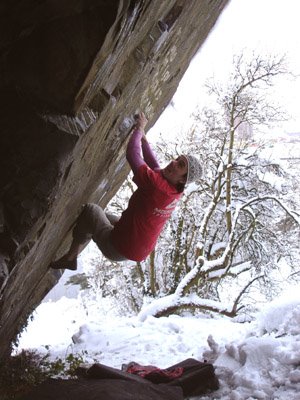
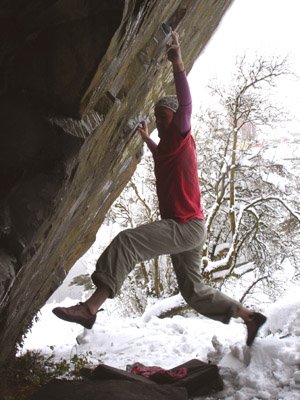
 Photo: Niall Grimes
OCC: I know you emphasise the benefit of doing a huge volume of routes in your progression. What additional training do you do on a regular basis such as weights, campusing, fingerboarding etc?
Lucy: As I said, I do weights regularly. I’ve never really got into campusing etc. Partly because I think I would break/injure myself if I went for it, partly because it’s hard-core and more so because I find I can make improvements doing other things I enjoy more. I’m sure if I had done more of this, maybe I would’ve improved quicker but I feel my body wouldn’t have coped with it very well (not very strong fingers and not the best strength to weight ratio for this style of training).
OCC: Who have been your role models in climbing and how much have they helped you? Have they been mainly male or female and is that just coincidence? Do you think it’s important for aspiring female climbers to climb and compare themselves to other female climbers, male climbers, both or does it not matter?
Lucy: I’m not sure I’ve consciously had role models, I don’t seem to work like that. I’ve been lucky enough to climb with many very good climbers over the years, like Ian V and Ben B and I’m sure I picked up things along the way but I tend to look at what I’m doing and work out ways to improve. I’ve always chatted to my peers about what they do and how they train etc but at the end of the day you have to find out what works for you through trial and error.
I think comparing yourself can lead you up a blind alley sometimes. It’s good to admire what other people are doing but as I said you’ve got to work out what works for you, we’re all different.
OCC: Female climbers have a disadvantage compared to males in terms of potential for developing strength, what strengths or advantages if any do you think females have that they can use to offset (or eliminate??) the difference?
Lucy: Yes we are at a definite disadvantage here. It’s interesting watching the juniors grow and develop; I’ve had some interesting chats with some of the young lads. You won’t see them for 6 months, the last time you saw them they were puny little weeds and then the next time you see them they are these muscle bound young men who can do 2 finger one arm pull ups on a pocket! They haven’t done anything different, sometimes they haven’t done anything, they’ve just grown muscles. This rarely happens to girls, you don’t wake up with muscles popping out everywhere and pulling one armers.
At this stage, the boys generally overtake the girls quite dramatically, mainly on steep stuff though. The girls just have to play catch up for a while trying to work on their strength deficits. I suppose an obvious difference is that girls really have to use what strength they have in a very economical way, which will generally mean developing a good technique (this is not to say guys don’t have or need good technique). Also, girls tend to work on their flexibility more and this can be a useful tool for ‘bending’ round hard moves. I think if you were a guy with all these attributes, it would be very hard for a girl to be better.
OCC: What do you think you need to do to climb even harder grades than you do now (assuming you want to!), that you aren’t currently doing?
Lucy: I spent the winter trying to improve my bicep and lower ab strength. These have always been two of my weak links. I was also working lock offs and reverse negs. All this combined has definitely made a difference to how I feel on routes. It’s made a difference to my grade but not a huge one. Making big gains at this stage is hard. However, I definitely feel better on routes.
I think I need to carry on with these weaknesses (when I go away on a months climbing trip, by the end of it those gains have pretty much gone, it’s a case of starting from square one again. Just going hard sport climbing does not, for me, work my particular weaknesses.
The other thing I could do, would be to wake up and miraculously have developed some power and be able to do one armers but that isn’t going to happen- oh well!
OCC: What other female climbers have inspired and/or informed you and why?
Lucy: When I first started doing comps, Fliss Butler was the queen of rock. I didn’t really know much about her as I wasn’t a big climbing magazine reader (I think it’s more of a guy thing) but she was an inspiration because she was awesome in the comps and on the rock, a woman after my own heart. And of course Lynn Hill, what can I say that hasn’t already been said. She’s pretty much one of a kind- you don’t get many Lynn Hill’s to the pound,
OCC: Finally, do you have any hard earned pieces of wisdom for female climbers that you wish you’d been told when you started to climb seriously?
Lucy: I can’t think of one nugget. But I suppose things like:
• Try not to let other people tell you what’s best for you, only you know what works for you and your body.
• Don’t be afraid to experiment, even if it feels like one step forward two steps back at times. Get in there and fall off boulder problems and routes, it’s the only way to improve.
• Have the strength of your convictions. If you want to work out your own way to do a move, do that. Find the inner confidence to tell your climbing partner to "shut up and mind their own business" (in the nicest possible way). What works for a 5’10” guy, will generally not work for a 5’2” girl.
• Girls, yes we are short, yes we are weaker. Unfortunately, that’s life, get over it. Try to work with what you’ve got. Get extra strong at locking off etc to gain height. There are ways round these things. But you do need to get stronger, if you want to push into the harder grades. We all know strength isn’t everything but it helps a lot.
• Finally, don’t let anybody tell you can’t do something, that’s solely your decision. Try to break the mould of deferring to men, be your own boss. I hope I don’t sound like a man hater because I’m absolutely not. But they will try to take charge of a situation, show them that you can look after yourself and your climbing needs. This is as much the fault of women as it is men. Be your own person.
Thanks Lucy and well done on your second 8b!
Lucy: As I said, I do weights regularly. I’ve never really got into campusing etc. Partly because I think I would break/injure myself if I went for it, partly because it’s hard-core and more so because I find I can make improvements doing other things I enjoy more. I’m sure if I had done more of this, maybe I would’ve improved quicker but I feel my body wouldn’t have coped with it very well (not very strong fingers and not the best strength to weight ratio for this style of training).
OCC: Who have been your role models in climbing and how much have they helped you? Have they been mainly male or female and is that just coincidence? Do you think it’s important for aspiring female climbers to climb and compare themselves to other female climbers, male climbers, both or does it not matter?
Lucy: I’m not sure I’ve consciously had role models, I don’t seem to work like that. I’ve been lucky enough to climb with many very good climbers over the years, like Ian V and Ben B and I’m sure I picked up things along the way but I tend to look at what I’m doing and work out ways to improve. I’ve always chatted to my peers about what they do and how they train etc but at the end of the day you have to find out what works for you through trial and error.
I think comparing yourself can lead you up a blind alley sometimes. It’s good to admire what other people are doing but as I said you’ve got to work out what works for you, we’re all different.
OCC: Female climbers have a disadvantage compared to males in terms of potential for developing strength, what strengths or advantages if any do you think females have that they can use to offset (or eliminate??) the difference?
Lucy: Yes we are at a definite disadvantage here. It’s interesting watching the juniors grow and develop; I’ve had some interesting chats with some of the young lads. You won’t see them for 6 months, the last time you saw them they were puny little weeds and then the next time you see them they are these muscle bound young men who can do 2 finger one arm pull ups on a pocket! They haven’t done anything different, sometimes they haven’t done anything, they’ve just grown muscles. This rarely happens to girls, you don’t wake up with muscles popping out everywhere and pulling one armers.
At this stage, the boys generally overtake the girls quite dramatically, mainly on steep stuff though. The girls just have to play catch up for a while trying to work on their strength deficits. I suppose an obvious difference is that girls really have to use what strength they have in a very economical way, which will generally mean developing a good technique (this is not to say guys don’t have or need good technique). Also, girls tend to work on their flexibility more and this can be a useful tool for ‘bending’ round hard moves. I think if you were a guy with all these attributes, it would be very hard for a girl to be better.
OCC: What do you think you need to do to climb even harder grades than you do now (assuming you want to!), that you aren’t currently doing?
Lucy: I spent the winter trying to improve my bicep and lower ab strength. These have always been two of my weak links. I was also working lock offs and reverse negs. All this combined has definitely made a difference to how I feel on routes. It’s made a difference to my grade but not a huge one. Making big gains at this stage is hard. However, I definitely feel better on routes.
I think I need to carry on with these weaknesses (when I go away on a months climbing trip, by the end of it those gains have pretty much gone, it’s a case of starting from square one again. Just going hard sport climbing does not, for me, work my particular weaknesses.
The other thing I could do, would be to wake up and miraculously have developed some power and be able to do one armers but that isn’t going to happen- oh well!
OCC: What other female climbers have inspired and/or informed you and why?
Lucy: When I first started doing comps, Fliss Butler was the queen of rock. I didn’t really know much about her as I wasn’t a big climbing magazine reader (I think it’s more of a guy thing) but she was an inspiration because she was awesome in the comps and on the rock, a woman after my own heart. And of course Lynn Hill, what can I say that hasn’t already been said. She’s pretty much one of a kind- you don’t get many Lynn Hill’s to the pound,
OCC: Finally, do you have any hard earned pieces of wisdom for female climbers that you wish you’d been told when you started to climb seriously?
Lucy: I can’t think of one nugget. But I suppose things like:
• Try not to let other people tell you what’s best for you, only you know what works for you and your body.
• Don’t be afraid to experiment, even if it feels like one step forward two steps back at times. Get in there and fall off boulder problems and routes, it’s the only way to improve.
• Have the strength of your convictions. If you want to work out your own way to do a move, do that. Find the inner confidence to tell your climbing partner to "shut up and mind their own business" (in the nicest possible way). What works for a 5’10” guy, will generally not work for a 5’2” girl.
• Girls, yes we are short, yes we are weaker. Unfortunately, that’s life, get over it. Try to work with what you’ve got. Get extra strong at locking off etc to gain height. There are ways round these things. But you do need to get stronger, if you want to push into the harder grades. We all know strength isn’t everything but it helps a lot.
• Finally, don’t let anybody tell you can’t do something, that’s solely your decision. Try to break the mould of deferring to men, be your own boss. I hope I don’t sound like a man hater because I’m absolutely not. But they will try to take charge of a situation, show them that you can look after yourself and your climbing needs. This is as much the fault of women as it is men. Be your own person.
Thanks Lucy and well done on your second 8b!