29 April 2007

The Self-Coached Climber review


[Update 2/11/2009] Since this book really is still the best book on improving at climbing on the market right now, and so many of you read the review, I thought it would be a good idea to get some copies in for my webshop! It's here.

The Self Coached climber is the latest in what is now a long list of books on improving your climbing performance on the market. In fact, for the inexperienced eye, it is for the first time getting tricky to decide which is the best buy. So where does Hague and Hunter’s new book fit into the available literature, apart from bringing us up to date with recent knowledge? In my opinion, this book blows away the previous publications, and sets a new standard in self help training books in rock climbing.

To start with, lets look at the scope of the book. For the first time, the authors lay out in detail the importance of establishing balance on the rock, what balance actually means in a rock climbing situation and provide superb descriptive and illustrative examples of balance in action on the rock. Establishing balance underlies all successful movement on rock and any climber will benefit from this tutorial in how different body and limb positions affect your ability to move and the forces on the holds. Beyond that, there is a comprehensive run through the main movements in climbing, with supportive graphics to help you see what is going on in each movement. Right through, the writing and illustration is faultless and shows groundbreaking effort in communicating these ideas in a clear manner, an obvious testament to the author’s decades of experience in coaching climbers. The following chapters take us through the fundamentals of all types of training for climbing, including mental training and putting all the elements of training together, in a far more practical way than other books have managed to do.

The content is detailed and thorough which might occasionally be a little heavy going for beginners. This trade off between detailed information for advanced experts and accessible writing for beginners and the ‘not-so serious’ climber will always be a tricky balance to strike with this type of book. I think they have pulled it off by structuring the book well into shorter essays and enough graphics to do the job without actually referring too much to the text. The real killer though is the accompanying DVD. When I first hit play I was expecting something pretty cheesy and not exactly captivating, but it really surprised me with well organised concise exercises and superb animations which surpass anything before it including Neil Gresham’s DVD instruction on climbing technique (although this is more comprehensive). The chapter of the film covering redpoint tactics is superb too, bringing the lists of tactics alive by following two climbers on the rocky road to linking a route right at their limit over several days. This could have been even better with some additional commentary at the end, but still leaves you more educated about the critical importance of tactics than before.

This is a substantial publication and the price reflects it, but I’d say it’s worth every penny and more for the quality and scope of the information inside and the way it is presented. There’s no doubt that a keen beginner climber picking this book up will feel a touch overwhelmed by some of the chapters. But this is a reference book; keep this in mind. Beginners will get a huge amount by reading over and over the sections on balance, initiating moves and watching the associated sections in the DVD. This is the same kind of content that any climbing coach will have you do again and again, because its so critical to build further layers of ability on top. After the initial read, what you need from a book like this is for it to be easy to pick up and flick back to a section that’s on you mind at a given moment, such as getting home from a frustrating training session, or getting close to a hard route and needing an extra edge. The authors obviously had this in mind when laying out the book and deciding on graphics – its not a chore to use or difficult to relocate particular notes within the book quickly and easily.

So do I have anything bad to say about the book? Not really, all of its content is spot on. I would have liked to see a chapter on common climbing injuries since their prevalence is so high these days among climbers, and perhaps a little more on onsight and redpoint tactics in both the book and DVD. So it’s not 100% perfect. But this is already a massive publication and really puts the rest to shame. Even today with more and more climbing coaches around, the vast majority of people coach themselves in climbing, and make crucial decisions about sourcing information with very little to go on. For these climbers, this book should be the most used looking book on their shelf.

If you would like a copy, you can get it from the webshop here.

The Rock Warrior's Way review

Some books demand extra special attention. You hardly have to read a few pages of Arno Ilgner’s book on mental factors in climbing to realise that this work is an expression of a lifetime of research, study and passion in a subject that has eluded scientific understanding and mass participation with the passage of time; mind control during risky climbing. The intention of the author is to equip you with the means to take control of this, the most elusive of performance elements in climbing and start to make lasting changes. Quite a task.

The angle taken by Ilgner in approaching this is inevitably influenced by his background, incorporating both psychology and various philosophical approaches and fields for reference, example and guidance. We cannot fault Ilgner for taking this approach. Even in this century, the workings of the mind in the area of risk and fear have continued to confound standard scientific approaches for study and developing good practice, and we surely cannot discount at least some of what ancient and alternative philosophies might have to offer sport mental performance? When studying sport psychology myself I was surprised (but later no so) to learn that universities still regularly debate whether to offer psychology related degrees within their science faculties and even if this discipline can be justifiably called a science at all. The mind simply cannot be well understood by applying current day scientific method. That said, my scientific defences were already up before I even got out of the introductory chapter when Ilgner makes reference to possible “divine intervention” in his life!

Some, especially a British audience might well get ‘the fear’ just from the book’s rather romantic title. Do we really want to become “rock warriors”? The book is without a doubt steeped in Ilgner’s personal love for ‘warrior’s way’ philosophy and how it has worked for him in succeeding on bold rock climbs. But it’s also doubtless that there is much to learn from his book.

So what elements of value came out of the read for me? Well, the biggest benefit to be had is truly learning that mental performance in climbing is a process, not a sudden event to be conjured out of the depths of your mind when 20 feet out from a runner. And that process starts long before you even tie onto the rope at the base of the route. It also refocuses you on using your mind as a tool to get clearer understanding (and therefore control) over the actual task you are setting yourself when leading a route; observing the right things, focusing on the right tasks at the right time, eliminating extraneous and inhibitory thoughts and tasks and the steps that need to be taken to arrive at the moment of truth – commitment.

Also the power of adopting ‘the witness position’ as Ilgner refers to it, of stepping out of your body and how this can help you make better an more informed decisions on courses of action during climbing and also to prepare yourself to focus on the right things. In fact, throughout the book I recognised most of the mental strategies that have lead to the best performances by climbers operating at the limits of climbing of all types, including bold routes. However, at times I found the writing may have benefited from the influence of more co-authors to sharpen up the key messages and distil out some of the surrounding text that occasionally clouds what are essentially simple practices. For the reader, this means some hard going at times, and I would recommend reading it a couple of times (if you are up to it!) to get Ilgner’s key messages well understood and internalised.

The big question is of course will it actually help you control your fear and reach your potential on bold leads? For some I think it will help, and many of my clients who have read it report that they benefited from it. However, I feel that the practical advice in the Rock Warriors Way may be in need of further development and readers may be left wondering how they can realistically put their new knowledge into practice. This is where a truly effective coach, or self-coaching manual succeeds or fails – in recognising that integration of theoretical knowledge and day to day practice is the most critical aspect for getting to the next grade. Some climbers may be left needing more advice in translating knowledge into results by using the strategies on real life climbs. It is a lot to ask of one book though; to make a comprehensive picture of the theory and provide detailed practical advice as well in what is a massive subject. Ilgner has focused on the former objective.

However, they will have been well educated in the theory behind boldness by The Rock Warriors Way, and at times entertained by the language and terminology that you only find in mental self-help books, especially American ones! So, adopt the warrior position, breathe deeply and prepare for a long night’s reading, possibly aided by some strong coffee to get to the end. But, if you can find a way to put Ilgner’s wisdom into practice, you might just be OK out there on the sharp end next time round??

Climbing Your Best review

American climbing coach Heather Reynolds Sagar has compiled her knowledge of performance in climbing and produced a book detailing good practice in training for climbing. This book is mainly focused on training, with mention only of common climbing positions but little on constructing movements, so I would recommend using it in conjunction with some other source of learning to cover these aspects, as training is only one link in the chain of performance. The book translates the author’s experience as a coach and some application of the limited sports science research so far completed in climbing – a good premise, but does it work?

To start with Heather gives us a battery of tests to perform to assess our strength and fitness parameters in order to establish our strengths and weaknesses before moving on to developing training goals. At the end of the chapter you can compare your scores to ‘normal’ values for climbers at each grade based on data collected by the authors during her coaching experience. This is a good attempt to establish real numbers for strength and fitness targets for climbers. But I would say the ‘normal’ values must be questionable to say the least and we have no assurance of the size of the sample or methods used to collect the data. These might be useful as a ‘wake up call’ for those a mile off the required level for their goal grades, but trying to follow them to the letter (as some inevitably will) could be dangerous! I have to say I skipped right past this chapter, and would advise anyone else to view it with interest but not take it as gospel.

The next chapter is more promising with ‘signs and symptoms’ of potential weaknesses, based on things climbers can see or feel without having to perform exercise tests. This will be much more practical and appealing to a lot of readers. I was glad that Heather warns us of the interaction between technique limitations and physical ones but doesn’t provide much advice to guide us through the common pitfalls of self-analysis.

The following chapters detail good practice in strength and endurance training for climbing, but not technique and mental training. There is also a chapter in climbing injuries which was helpful, but only as a quick run through of preventative techniques, with little information on what to do if you actually get injured – an opportunity missed. I was also disappointed to see good footwork absent from the lists of high risk situations for injury; it is the most common! The book finishes with a run through of common myths about improving at climbing. I liked this section although again it would have benefited from being tackled more thoroughly and might have been better included as a discrete “climbing myths” section in its relevant chapter, rather than at the end, where some readers may have switched off.

Talking of switching off, I found that the layout and writing style in the book was by far its biggest limitation. The first time I read it, I found it pretty hard work (and I LOVE reading this kind of book!) and was pretty disappointed. Second time round, I realised that much of the content is actually sound, if a bit limited. I realised that the lack of structuring of the sections and text and overworked examples defeat the reader, and the decision to abstain from supporting the text with pictures and graphics compounded this. No doubt this was a commercial decision, but may have been a false economy!

It will appeal to those wishing to understand more about physical training for climbing, without spending days reading it, although you may have to give it a couple of read throughs to get to grip with the messages it contains. Its also a good choice if you have a limited budget, but will have to compete hard with the other books out there which offer at least as much value per pound/dollar.

24 April 2007

Recruitment


Dave Redpath setting up for the crux of Anabolica 8a, Siurana – never mind that recruitment Dave, can you up that firing frequency, coordinate those neural waves and reduce the inhibition enough? (Ph: Hot Aches)

Based on the information in books out there about training for climbing, it has become many climber’s understanding of muscular strength and strength training that it comprises of two elements; muscle size and muscle fibre recruitment. This understanding is useful at a very basic level because it helps to underline the point that getting strong for climbing is not just about getting bigger muscles. Even for those not interested in training, it helps us to understand our observations that the best climbers are clearly not the muscliest! This is nowhere clearer than if you compare the physique of two of the world’s most famous and best climbers of today, Dave Graham and Chris Sharma.

But if you are at the stage of planning your own training for climbing based on your knowledge of strength and the factors that influence it, then it pays to have a deeper understanding to avoid making poor choices and losing out on training gains.

Muscle strength is indeed influenced by the size of the muscle and the number of fibres it can recruit, but its also influenced by the frequency of firing (rate coding) of the muscle fibres, the length of the muscle, the speed of contraction, the reflex potentiation or inhibition of the muscle and the coordination of the muscle group (after all movements involve several muscles working at once through different stages). Beyond these there are even more factors besides! So in reality there is quite a lot going on there. This helps us to see why the best climbers come in different shapes and sizes and appear to move in different ways.

So what do all of these factors mean for our strength training. I guess the best way to summarise this would be to say that the demarcation between muscular strength and technique is not as clear as it may seem. I’m not going to go into all the implications because there are several books worth of them! But the main implication is to recognise the importance of integration of gains in both tissue growth and the neuromuscular activation aspects (recruitment & rate coding) in the setting you are ultimately training for.

In real terms this mean making sure you mix up basic strength training on things like fingerboards with bouldering. This will ensure that your muscles learn the correct rate coding for given movements. In some cases this will be learning to use more force, in some cases it will be less. Both are obviously just as important, as in climbing we have to string moves together so strength is a commodity that we must save on certain moves and be able to use in abundance on others.
In future posts I’ll write up some pointers to recognise when there might be a problem with the proportions of different types of strength training in climbing. But this is a very complicated subject and worth getting help with it if you can!

Layoff vs slow return to activity

One of the main worries climbers have after getting an injury is whether to take a complete layoff from climbing activity and how long that layoff should be. Some reading about rehab in sport will tell you that extended layoffs are very bad news not only for losing form but also recovering from the injury. Here is quote from a review of strength training in sports rehab which really rams home the point:
"it is now clear that during the remodeling phase, occurring theoretically from the 21st day after injury and even lasting 300 to 500 days, the collagen tissue remodeling can only take place efficiently when put under stress (or load)."
The initial layoff (up to three weeks) allows the acute phase of the injury to pass (that is inflammation causing swelling, tenderness and lots of nasty chemicals in the wound). Beyond that, it takes training for the injury to respond with improvements in exactly the same way as normal training, except of course that it is starting from a very low load capability. What has to be remembered is that sporting function is not normal function. If you layoff for a long period, an injury will recover to the point it can handle what is being asked of it (i.e. lifting kettles, tapping keyboards in some people's case!). You would'nt stop climbing for six months and then jump back on your hardest grade would you? So if you have an injury where the capability of the damaged tissue drops to a very low level, you shouldn't let it languish at that level and then expect it to suddenly perform a massive jump in standard by starting normal climbing again.
The bottom line is, rehab from injury is (beyond the initial phase) analogous to normal training, with progressive overload to stimulate the tissue to respond. All the aspects of normal training also apply; monitoring of progress, regular and stuctured exercises, careful lifestyle support (which in this case will include rehab treatments like Lewis reaction icing, stretching and maybe friction massage).

Elbow injury - lessons from tennis


Here is an interesting wee link to some summary data about rehab of Tennis Elbow on the Sports Physiotherapy For All website. Tennis elbow in climbers is pretty rare (I think, but there is no data on it!), but does sometimes happen. Where it does happen I suspect its most likely caused by a discrete event such as a sudden tear, or due to a very unusual climbing technique. The main reason I posted about the link was to draw attention to the comments about late stage rehab of this type of injury. In climbers this will more likely be medial epicondylitis or problems with brachioradialis, although it applies to any sports injury. The article stresses the importance of good technique and relying less on strength and making more fluid and efficient movements. This is most often the underlying cause of overuse injury in the first place, and the reason why certain people are plagued with repeated injury of the same type. In climbing, key risk factors for finger and eblow injuries are probably poor footwork, a 'rushed' climbing pace and a habit of locking off and pulling up to initiate moves rather than initiating movements with your feet. Of course, there are risk factors in the areas of training practice, nutrition and lifestyle and genetics as well, but these may be less significant that movement technique.
So, the message is clear - to prevent injury occuring or recurring, look at your movement technique.

30 March 2007

Off the Wall Exercises for Climbers – Review

Now most of us like our training for climbing to involve actual climbing. And not just for fun; specificity is the one of the core principles of physical training for sport. So weight training is usually off the list of priorities for most climbers. But not all of us can get climbing as often as we need to improve, but our jobs or schedules mean we have time to get to a gym or homemade training facility to make the most of what we can get. Lisa Wolfe’s book on strength exercises for climbers covers the range of exercises you can do away from climbing walls and crags. For those of you who only have access to a weights gym and know the areas or muscle groups you need to focus on, but not the exercises, then this book will be useful.

I was hoping for a bit more though. I expected to see a simple but thorough explanation of the pitfalls for climbers spending a large proportion of their overall training time using weights or basic strength exercises. The only discussion on this critical point is a passing comment in the introduction “Give off-the-wall training a try… What have you got to lose?” Quite a lot actually and the book fails to warn of issues such as the common loss of emphasis on good technique in many climbers for whom basic strength training gets addictive. Nothing on the pitfalls of developing large body mass on climbing specific strength-weight ratio either. No guidance for prioritising exercises for specific performance weaknesses. The book is a seemingly exhaustive list of exercises for all muscle groups of the body and not much more. The whole time you ask; “how do I choose which exercises are highest priority for me?”.

Readers will have to seek advice for which of the exercises to prioritise from other sources. This will keep coaches in business : ) The book is certainly useful as a reference is the training priorities for different circumstances are known, but the opportunity was there to make a book more complete for self coached climbers.

7 October 2006

lessons from Gadd

Will Gadd enjoying Ben Nevis - straight talking is what you need when you want to break out of a rut and improve, Will comes through for us!

The Gadd has posted 8 of his hard earned lessons on training over on his blog. In this post he's talking about a general approach to training, and says he's been re-learning all this wisdom in his rock climbing training recently, not the ice bashing he's really famous for.

The main overarching thing I noticed about Will's list of training thoughts is what I've been trying to get over in this blog and my own climbing blog - that the same rules of life, (work, laziness, lack of time, and general s**t like that) apply to everyone including folk like Will who climb hard. Try being a world class ice climber, rock climber and paraglider all at the same time and throw in lots of work writing books and designing gear - being a pro-athlete means you have to be better at plate spinning that anyone else, and there are more plates, not less!

The best climbers have the same issues as anyone else. A lot of the time it's just about bot accepting the setbacks and getting of your ass and making it happen. Once that attitude is there and you have accepted your circumstances and got on with it, then you can progress to the nitty gritty, and the results will always follow. As Will says "its not complicated... Not enough time, not enough food, too late, too early, too hot, too cold, whatever, there are always going to problems. Deal with it and do your best. Despite my belief that yesterday's effort was a less than perfect it was still a hell of a lot better than having done nothing, and I can feel my upper body did at least get some sort of workout despite the fact I could barely do my normal warm-up problems. I need to rest today to climb on Yam tomorrow, so I'm glad I got it done even if my ego said I sucked at the time. I didn't suck, I trained, and tomorrow I will be stronger for my goal."

Canadians can always be relied upon to give it straight, and Will is no different. Its worth reading his post, 20 years at the top of his game is wisdom worth taking note of. For more of the same, check out Will's book:

22 September 2006

Climber interview - Natalie Berry

From one Berry to another... I’ve had the privilege to interview one of the UK’s most successful young climbers on the indoor climbing scene (and she’s only 14!). Natalie Berry has already been a British champion five times and with her most recent successes on the international competition circuit, she has established herself as one of our most successful competition climbers of recent years. It’s obvious from watching Natalie in action that she has potential to take this ability much further. And I think its even clearer after reading her answers to my questions below that she has the single minded determination to turn potential into reality. Combining a mix of a great attitude like Natalie’s with good training and support at the right time is like mixing magic – its really powerful. So I think most of us have something to learn from her, even if its just sharing a little of that determination…


Natalie Berry
OCC: What age are you now Natalie and how long have you been climbing?

Nat: I am 14 years old and I have been climbing for 6 years – I started by chance when I visited a shopping centre in Glasgow where there was a mobile wall outside!

OCC: What are your best achievements so far in climbing and what are your goals for the future?

Nat: My best achievements so far have been coming 4th in the World Youth Championships in Austria in August 2006, and becoming five times British Champion (The BRYCS, BBC twice & BICC, twice). I aspire to be both European and World Champion in the next few years!

OCC: Tell me about your climbing motivation – why do you climb and how important is it for you? Do you think your climbing motivation has changed any since you started?

Nat: I find it quite easy to be motivated for most things in life – I am driven by a burning desire for success. I climb because I enjoy the freedom of movement and feeling of power that the sport gives me. I also enjoy the fitness – both physical and mental – that I have earned over the years. The mental science of climbing is particularly interesting to me – whether I’m in a competition or simply in training, I find it very interesting psyching myself up to climb, articulating movements and co-ordinating techniques.

OCC: How much training do you do? Do you separate climbing for fun and training, or are they one and the same? Tell me about the elements of your training – what activities do you do?

Nat: I climb four days a week. I incorporate anaerobic training (forearm endurance), some circuits, on-sighting, red-pointing – a mixture really. My training schedule is organised around my events calendar, but I often just follow my instincts and do what I want. I have found that I respond quickly to intense training and enjoy working hard to achieve my goals. I also do pull-ups and other climbing-specific training at home each day. I believe success is 90% hard work and 10% talent.
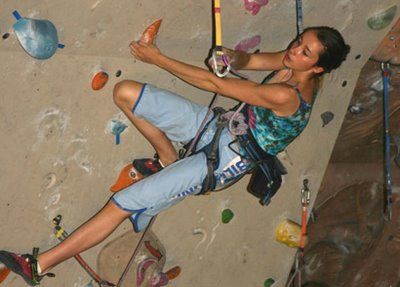
Natalie training in Imst


OCC: Lots of female climbers are put off or struggle with steep climbing and powerful or bouldery moves. Is this a limitation for you? If so how have you tried to get round it or work on it?

Nat: I have very strong static lock strength and so I therefore often use it to my advantage! Because of my build I have had to work on power, particularly as most international competitions take place on steep, powerful routes – unlike those in walls here in the UK!

OCC: Do you have any elements of your training that you find a chore? I remember reading a article by Marc le Menestrel talking about how he tries to find ways to get to like his dislikes in climbing or training, and that this really helped him progress. Can you relate to that or do you just like everything about climbing!?

Nat: I am lucky in finding training fun – most of the time – and I have great friends whom I see regularly down at the wall and can climb with, making training even more enjoyable. There are days, however, when I have to motivate myself when I’m feeling low! I use competitions and other big events to psyche myself up. Sometimes I just have to remember how it felt the last time I was climbing well, and I push myself to get back up to where I was before.

OCC: Describe your climbing style. Do you think your natural style is good for steep indoor routes or have you had to alter it in any way (i.e. movement pattern, climbing speed etc…)?

Nat: Technique has always been my strong point. I believe I am a very natural climber – I have a good store of engrams in my mind! I have quite a slow climbing speed, so on steep routes I really need to learn to climb faster. I prefer technique over power and I particularly enjoy really crimpy, fingery routes that many strong male climbers can’t do!

OCC: How do you fit all your climbing in with the other things in your life like study and social stuff?

Nat: I always strive for success, so find it quite easy to make time for my schoolwork – I am the Junior Proxime Accessit of my school. I think it is important to show the same care and devotion in all aspects of life – whether it be in sport or academically. My social life is my climbing life really – as I said before I have so many great friends all around the world. At home in Glasgow my climbing friends are really supportive and I enjoy helping them and others with their climbing too.

OCC: You specialise in indoor climbing – How important do you think it is that you train at a good climbing wall? What do you look for in a good climbing wall; big steep routes? a good scene? Other things?

Nat: I think it is incredibly important to train at a good climbing wall – all you have to do is look at the results the European juniors (and seniors) are achieving on the international competition scene, and then visit a few of their walls and understand why! It is not necessarily true that they are simply more talented than other competitors or that they “train better”, but their success – to me – seems to grow from the World-class facilities that they train on. I spent two weeks training in Imst, Austria – where the World Championships were held – prior to the competition. I realised just how beneficial it would be to have such a facility here in Britain. Climbing at Imst is like playing vertical chess. You have to weigh up the steepness of the wall - 45 degree pillars with numerous bulges and roof sections – as well as having to clip many 2 foot long quickdraws, on all 18 metres! I saw countless children from about the age of three or four and above top-roping– and maybe seven or eight year olds leading through the steepest sections of wall. From that moment I realised just how different the foreign attitudes towards climbing are from those here in the UK –start the kids young, encourage them, add some fun and watch them win.

OCC: What do you think is holding you back from getting even better results in comps than you get now?

Nat: I definitely think that the major ingredient missing from my training here in the UK is a European-style training facility – if we want British competitors on the international podium then this appears to be the way forward. I just wish I could have the funds to train abroad if we can’t have the facilities here. I would like to sport climb outdoors more but due to time and financial restraints I am quite content with focussing on indoor climbing for now!

OCC: What climbers most inspire you and why? Having competed on the international circuit what things have you learned from climbers around the world?

Nat: I am inspired by many climbers – not just world-class athletes but also beginners and climbers I’ve met of all ages and abilities – after all “the best climber in the world is the one who is having the most fun”. Neil Gresham has given me a lot of support and encouragement – I admire the positive attitude which he brings to the sport. Angela Eiter of Austria has also impressed me with the array of international competition titles she has won. All of my climbing friends (many of whom I compete against) inspire me too – I love learning from other people and find it very interesting studying their styles and techniques in training and competition. I think it is so important to learn from others and equally that they learn from you; everyone is unique in their climbing, both mentally and physically. I think I’ve learned a lot about life from my travels and competitions – I believe I’ve attained a lot of wisdom from meeting different people of all backgrounds and personalities from all around the world. One common factor I have noticed that bonds all the competitors at a competition is a love of climbing – a desire and determination to succeed, no matter what. After all, out of dreams comes determination, and out of determination comes success…


Natalie has managed to align enjoyment of the process of climbing and training to a clear goal for what she wants to achieve. In this way, more work and dedication equals more fun. This interview raises the important point of what outside support do climbers need to get to where they want to go? In Natalie’s case, she needs access to high quality training facilities to compete at the level she is capable of. As we don’t have steep enough climbing walls in Scotland just yet, this means travelling, which takes money. In most other people’s case, outside support might be as simple as reading some training advice like this website! Natalie has already gained some sponsorship from Scarpa, Glasgow Climbing Centre, Entreprises and Cotswold, but found it hard to secure the levels of support she needs and is hoping to find new sponsors. A familiar story for top climbers. She’s been a nominee for the young sports person of the year, a regional award that eventually went to athletes from Olympic sports who were not selected for international competition like Natalie! Olympic sports are being targeted for encouragement in the UK at the expense of all others right now, for obvious reasons.

This is an interesting subject which I’ll talk more about in future posts. I am no expert on making a living out of climbing although I have been trying myself for a few years. My experience is that the climbing industry is simply too small for most companies to afford the levels of support it takes for an athlete to succeed. The solution? Well there isn’t an easy one. I guess the most productive way for climbers who want to gain sponsorship is to take ownership of the problem of the size of the sport and use their experience and status to promote it to help the sport grow in whatever mediums they choose. Ultimately, giving the sport a higher profile will benefit everyone. More on this later…

Thanks for talking to me Natalie, keep up the determined approach and the results will keep coming! Click here to see Natalie’s website.

14 September 2006

Climber interview - Adrian Berry

Next up in OCC's series of interviews is Adrian Berry, one of the better known british trad climbers and one of our most experienced coaches. In his climbing career Adrian has climbed E10, redpointed 8b+ and been a member of the British competition climbing team. He's begun to coach climbing more and more and I was interested to find out what patterns he's noticed in climbing over recent years and how he's responded to these with his climbing and his coaching.


Adrian Berry (Photo: Duncan Skelton)

OCC: How do you think fashions in the climbing scene affect how climbers at large train/prepare for their routes?

Adrian: To be honest Dave, I think fashions in climbing affect a very, very small number of climbers, generally operating at the higher grades. If you look at, say, deep-water soloing for example, it seems to have exploded in popularity, but in fact there are maybe a couple of hundred climbers at most doing it regularly, there are probably more aid climbers. I would say that considerably less than one percent of climbers actually train, a lot go to the wall, but it’s used as an extension of climbing outside and a bit of a social, more than a training facility. I think this is largely down to the improvement of climbing walls, they are just a lot more fun now.

OCC: What changes have you noticed in climbers over the last decade – are they stronger? fitter? mentally tougher? Moving better? How do you think climbing walls are influencing standards and fashions?

Adrian: I don’t think much as come along in the last ten years, to be honest. Ten year’s ago, the hardest route in the UK was Neil Carson’s The Big Bang (9a), at the time there were maybe a couple of other people capable of that grade in the UK – and the same is true now. There is a larger pool of climbers operating just below the ‘cutting edge’ than there was ten years ago, but I would say the average climber climbed about HVS back then, and still climbs HVS. You only have to go to any busy crag in the country, sit and watch, and you’ll see few climbers even taking on HVSs. I thin that this is simply down to a booming economy, people are earning far more than they were, with bloody big mortgages to pay off. The idea of quitting your job to go climbing just isn’t happening any more. Here in Sheffield there used to be a large climbing population on the dole, just training and climbing, arguably, the boom in standards was the result of the bust of the economy and vice versa, it’s no surprise that the country’s producing the most super-climbers are economically the least developed.

In a word, ‘it’s the economy, stupid’.

One more thing that has had a major change, has been the failure of the club system to educate climbers. Today, climbers learn the basics of safety, then they’re on their own. There’s no apprenticeship, you can belay OK? Right then, you’re a climber. This all began with the clubs stopping taking out beginners because of the fear of litigations. The rot started there. For the last five years, I’ve been working to try to reverse that by raising the profile of climbing coaching, which sorely needed to fill the knowledge gap. Fortunately, that’s one thing a booming economy is helping, economic restructuring has merely commoditised the advice that use to be ‘free’, still, it keep us in work, eh?
Photo: Duncan Skelton

OCC: When you coach climbing, what pieces of advice do you find reminding people again and again that surprises you?

Adrian: Boy, that’s a big one, here are some that spring to mind:

- Footwear choice – technical climbing requires technical shoes – you’ve got to have the right shoes, and yes, they will hurt for a bit.

- Rear wheel drive – thinking in terms of following a line of foot holds rather than hand-holds – getting stuck is 95% due to looking for hand holds as opposed to using obvious foot holds.

- Reversing – time and again, I watch climbers climb into the most strenuous position on the route, stay they as long as they can, they call to be taken onto the rope. Reversing – even to the ground isn’t going to get you a ticket from the ethics police – it’s just good sense!

- Following from the last point – I find many Brits obsess over ethics, and what they CAN’T DO, rather than what they CAN. Be positive!

OCC: In getting better at climbing, really attacking your weaknesses, dislikes and bad habits is inevitably the sticking point for climbers improvement. Which weaknesses have you overcome to get to the standard you’re at just now, and which have you still to overcome?

Adrian: I would say my biggest weakness is definitely my head. I like to be in control, and you can’t be all the time. I absolutely HATE falling off, and can go for years without taking a fall, which is really sad! I’ve been dropped, and smashed into the wall a few times, which hasn’t helped me. I have found that on a recent trip through France and Spain, by getting on harder routes onsight (I was working up to onsighting 8a) I found my head got really sorted, just because the climbing felt so hard I didn’t have time to get anxious. I also make sure I do a few practice falls early on a trip now, just to get my head in gear. I don’t think I will ever like falling off, but I’m not afraid to confront it and it gets easier. I have found that explaining dynamic belaying to my partner helps a lot. My other, big weakness is exposure – it really affects me, I have to admit that my tactic here is to avoid it!

OCC: What importance do you place on doing a high volume of easier ‘milage’ climbing (indoors or out) for the purpose of sharpening movement technique? Do you see it as being commonly neglected, or the opposite - overrated?

Adrian: I swear by it – 70% of my climbing is soloing VS – E1 on grit, I can go out and do thirty routes in a couple of hours – I absolutely love it and by the end of the day you move without thought, which has to be the end goal. You can’t really work technique on hard climbs, at least I can’t. It is also great for developing capilliarity (blood supply to your forearms), which makes recovery much faster.
OCC: Many climbers who are not interested in bouldering as an end in itself in climbing, don’t practice it in their training either. Do you agree with this and do you think these people should make the effort to do more? If so, why?

Adrian: There is this idea at the moment that bouldering is a new thing – rubbish, you only have to look at the new BMC grit guide (Burbage and Beyond) to read quotes about bouldering from the early 1900s! The difference bouldering makes to your climbing is stark – when I have a new client, I can tell almost immediately whether they boulder or not. Moving beyond HVS without bouldering is going to be really tough, not just because it’s really hard to develop the strength, and technical range to tackle the moves, but because bouldering teaches you how to TRY. Bouldering is about repeated failure, and getting use to it. It’s about slapping for holds in an all-but-hopeless situation with the hope that just maybe you’ll make it. Applying that to routes will immediately gain you a leap of several grades. I love bouldering – but bouldering with a small ‘b’. I’m not a big fan of Bouldering (capital B) with its sitting starts, and daft rules – but then I’m not very good at it!

OCC: What elements of training do you think have held you back from climbing even harder than your current level?

Adrian: When I was training a lot, back when I was on the British team, there was really no advice as to how to do it. I got into this rut of climbing laps on routes in the mid 7s, then flying out somewhere to compete on routes in the mid 8s – naturally, I didn’t manage too well. After I quit international competitions, I had a big rethink on training, and did my own thing, which involved circuit training, with lots of one handed dead hangs in stress positions – some clips – and at a much higher intensity. This made a massive difference. If I’d know this back then, I would have been getting into the semi finals – though I think I would have had to have been doing since the age of six to have won!

OCC: Is there anything that you know now as an experienced coach that you wish you’d known as a novice climber?

- Being afraid of falling is the single greatest limitation to your climbing.

- Take advice with sceptical mind – mind included.

- Beware of the BS – and never let a tale of woe stop you trying a route – routes are never as bad as climbers who’ve failed on them make them sound.
- Treat your partners better than you would treat any of your kit – they are far more important.
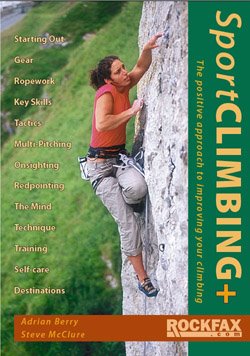
Thanks Adrian! I really like the idea of 'rear wheel drive' - thats something you can tell yourself in the heat of battle when you are about to come off. Adrian has been working on a book about improving at sport climbing which will be out in a couple of months. Click on the cover below to check out Adrian's coaching site.